Review Prior Law Rankings to Learn about the progress we’ve made
National Charter School Laws Across the States Ranking & Scorecard
2025
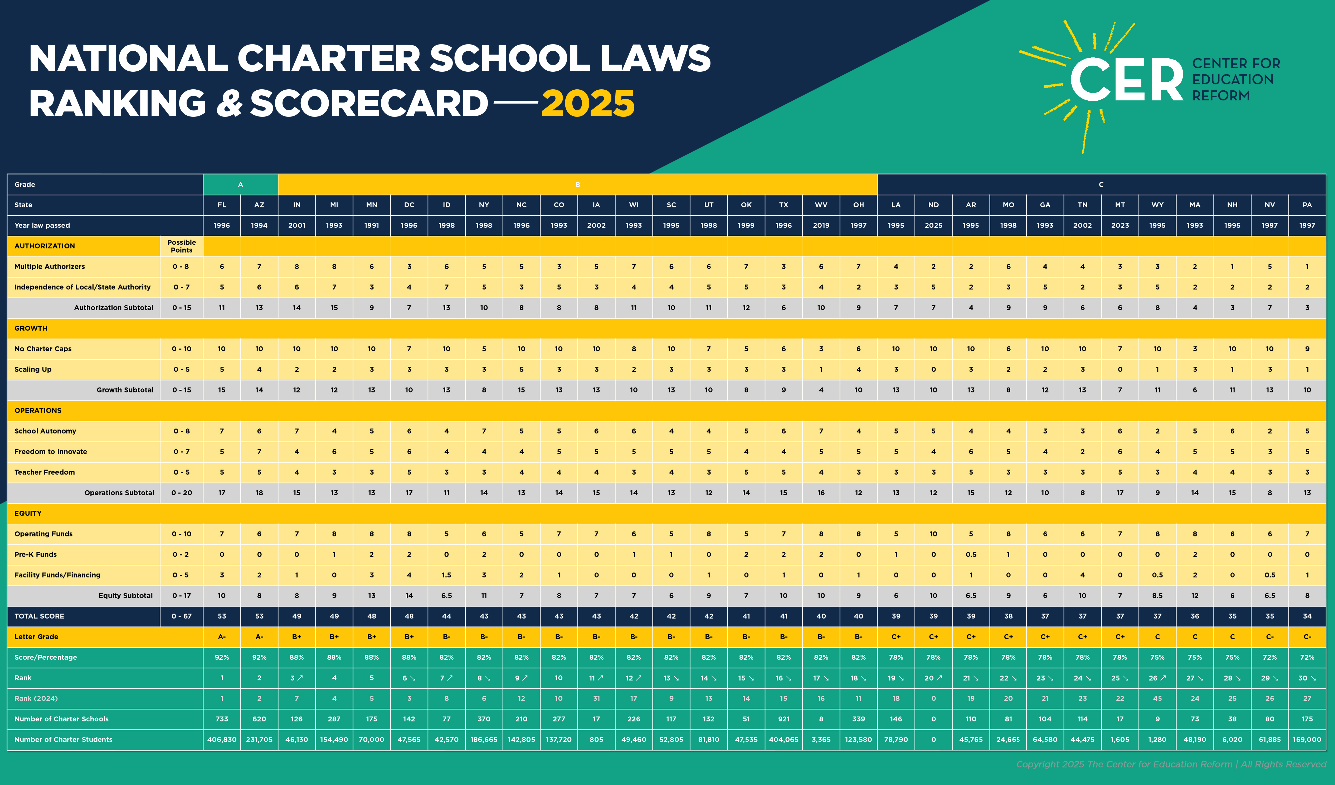
North Dakota became the 47th state to authorize charters, marking a historic shift and a strong debut at #13 in the national rankings. States like lowa and Indiana rose sharply in the rankings due to laws that reduced barriers to entry and addressed long-standing funding disparities.
2024
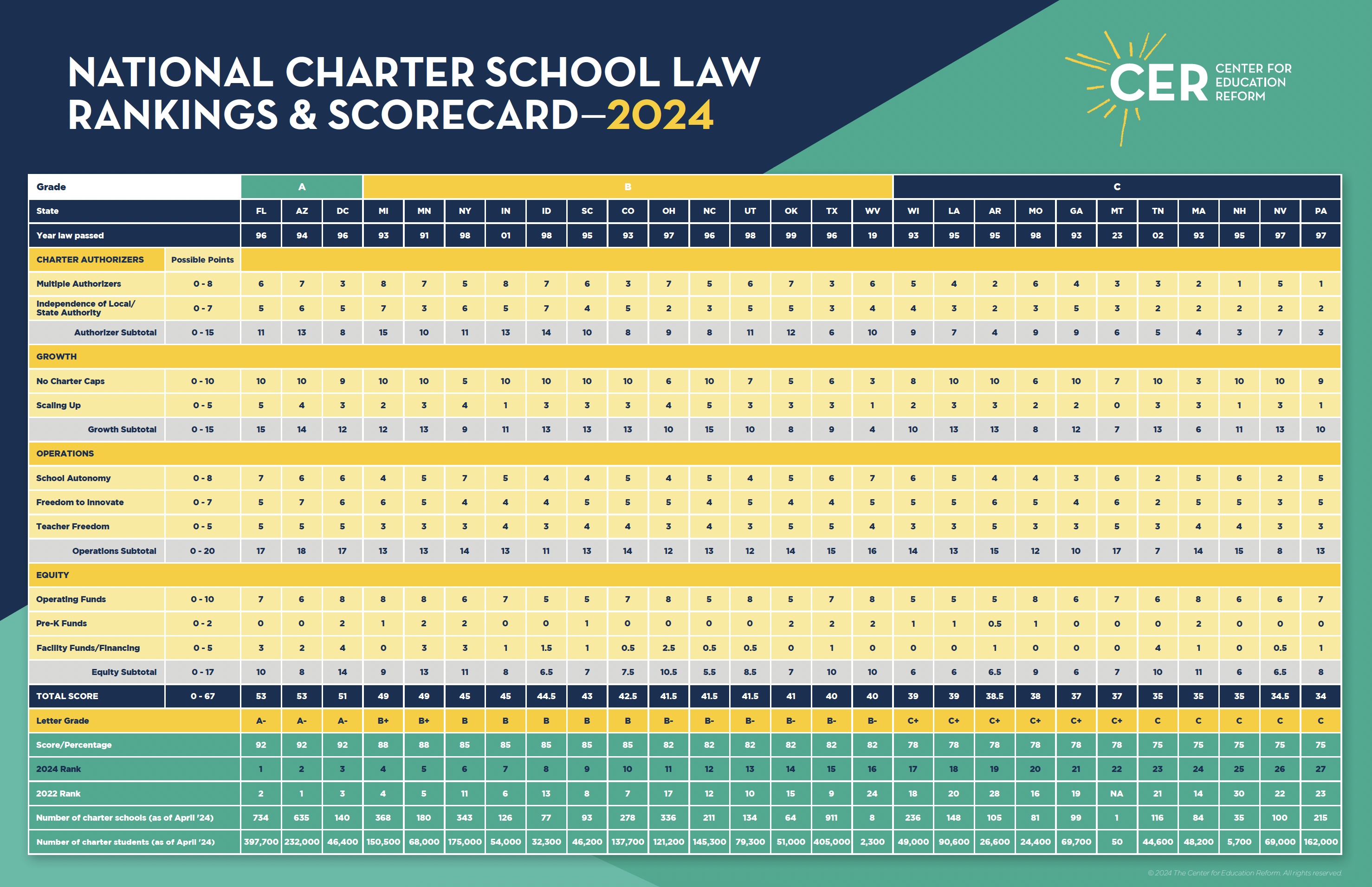
State rank and charter policy environments are improving, particularly in states that have tended to embrace education freedom in general. In 2022, only 8 states earned a “B” grade. In 2024, 13 states hold a “B.” Two states – Alaska and Iowa – moved out of the “F” ranking.
2022

The simple and original principle of charter schooling is that charter schools should receive enhanced operational autonomy in exchange for being held strictly accountable for the outcomes they promise to achieve. When charter school laws honor this principle, innovative, academically excellent charter schools flourish. In turn, schools that fail to produce strong outcomes close.
2021

As in years past, the national rankings carefully consider the impacts of overregulation, particularly on innovations in teaching and learning. And this year’s National Charter School Law Rankings & Scorecard goes a step further, providing case study examples of how regulations and other aspects of poorly conceived charter school policies impact charter operators and students. In addition to these case studies, CER also provides model legislation for policymakers to consider when crafting or amending charter school laws and regulations.
With this important guide, there is evidence-rich feedback and guidance to policymakers. With feedback and guidance, change is possible.
18th Edition March, 2018
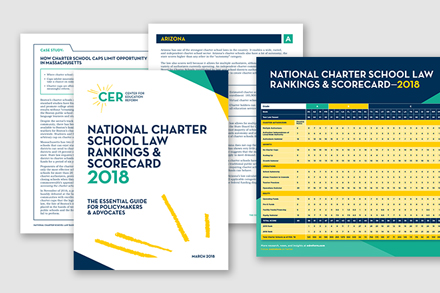
In 2018, there are almost 7,000 charter schools serving more than 3 million students in 44 states across the nation. More than 500,000 individual students are on charter school waiting lists across the country. Charter schools nationally serve more minority students and more economically disadvantaged students than their district counterparts. Individual charter schools are more likely than district schools to serve concentrations of students who live in poverty
17th Edition March, 2017
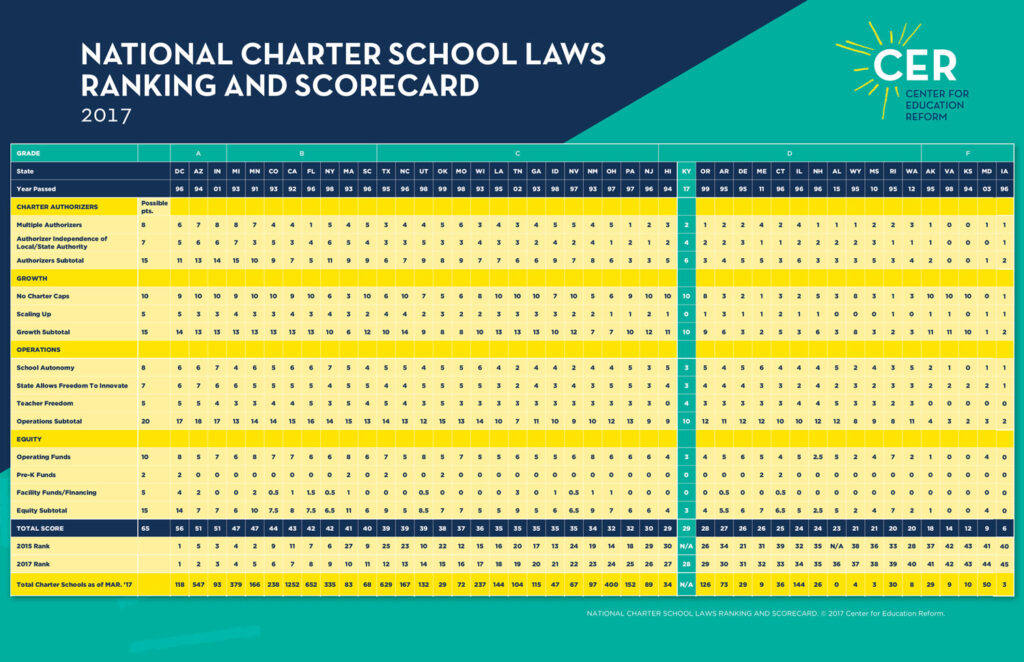
We are now well into the third decade since Minnesota passed the first state charter statute. The number of charter schools has continued to increase each year at a steady but relatively slow pace. But this past year, that growth abruptly came to a near halt. Overall, the nation’s nearly 7,000 charter schools still serve a fairly small percentage of the total number of students receiving public education, roughly six percent. Some states and cities have far more market share and point the way to what healthy expansive choice does for the whole of public education.
16th Edition, 2015

Charter School Law Rankings: Read CER’s 16th edition of Charter School Laws Across the States 2015 Rankings & Scorecard here.
“It is abundantly clear that little to no progress has been made over the past year. Charter school growth does continue at a steady, nearly linear pace nationally, especially in states with charter laws graded ‘A’ or ‘B,’ but an even more accelerated pace would allow charter schools to play a more central role in addressing the demands and needs of our nation’s students.” Read More.